Our Location
304 North Cardinal St.
Dorchester Center, MA 02124

304 North Cardinal St.
Dorchester Center, MA 02124

Ever walked into a room and forgotten why you came? It’s not a memory issue. It’s your brain reacting to space. This article explains how home design silently affects focus, intention, and mental clarity.
A small psychological fact you might’ve googled at 1 a.m
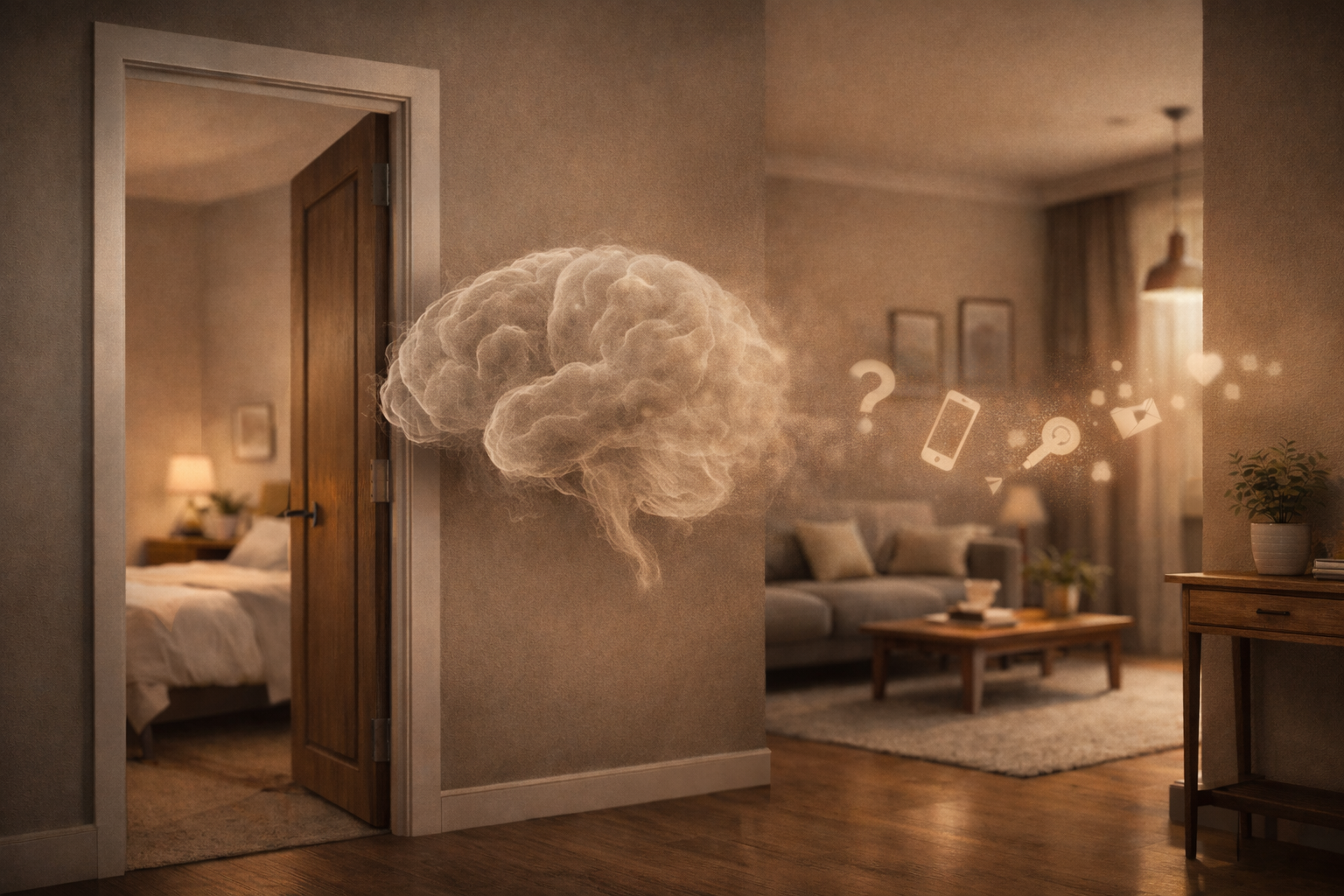
Forgetting why you walked into a room is not a memory problem. It’s your brain reacting to a change in environment. Psychologists call this a “context reset,” and it happens to almost everyone—sometimes multiple times a day.
If this happens to you often at home, your space may be quietly making it worse.
You leave your bedroom to grab your phone charger.
You step into the living room.
Suddenly—nothing.
You just stand there, trying to remember why you came. You replay your steps. You feel mildly irritated with yourself. Sometimes you even walk back to the previous room, hoping the thought returns.
It does.
And you think, Why does this keep happening?
If you live in an Indian apartment or builder floor—especially a compact home with rooms doing multiple jobs—this experience is more common than you think.
And no, it’s not because you’re distracted, lazy, or “overthinking.”
Your brain ties intentions to context.
When you decide to do something—pick up a charger, reply to a message, grab a notebook—your brain tags that intention to the environment you’re currently in.
When you cross into a new physical space, your brain subconsciously asks:
“Am I in a new situation?”
If the answer is yes, it briefly clears the previous mental tab to prepare for new information.
This is called cognitive context switching.
Doors, passageways, sharp visual changes, and even lighting shifts signal the brain that something has changed. Most of the time, this reset is helpful. But in poorly planned homes, it happens too aggressively.
That’s when your intention gets lost.
Your home isn’t just where you live—it’s a series of psychological cues.
Certain interior conditions amplify mental resets:
1. Abrupt room transitions
When one room feels completely different from the next—color, lighting, furniture density—your brain treats it like entering a new world.
Bedroom → bright living room → cluttered study
That’s three mental resets in seconds.
2. Clutter near entry points
Shoes, bags, random furniture, unused décor near doorways create visual noise.
Your brain gets distracted before your intention stabilizes.
3. No visual continuity
If nothing visually “connects” two spaces—no repeated element, line, or rhythm—your brain loses its thread.
4. Inconsistent lighting
Moving from soft light to harsh white light instantly changes your mental state.
Your intention doesn’t always survive that jump.
5. Undefined room purpose
If a room is part bedroom, part office, part storage—your brain doesn’t know what mode to activate. So it clears the previous one.
Check how many of these feel familiar:
If you nodded more than twice, this isn’t random.
You don’t need more storage units or new furniture. You need cognitive clarity.
Here’s what works:
1. Visual anchors
Give your brain something stable to hold onto across spaces.
This could be a repeated color tone, material, or design line that subtly continues from one room to another.
Your brain reads continuity—and holds the intention longer.
2. Intentional transition zones
A small console, a lighting shift that’s gradual (not abrupt), or a pause space between rooms helps your brain “carry” thoughts across.
Even 2–3 feet of visual calm makes a difference.
3. Clear layout logic
When furniture placement clearly signals what a room is for, your brain switches modes smoothly instead of wiping memory.
4. Lighting continuity
Match light temperature between connected spaces. Let brightness increase gradually instead of suddenly.
Your mind transitions better when your eyes do.
5. Purpose-first furniture placement
Place furniture to reinforce behavior:
Your brain remembers better when space and purpose align.
When you live in a space every day, your brain adapts.
You stop noticing what’s causing friction.
Designers are trained to spot:
These aren’t aesthetic problems.
They’re behavioral ones.
And they’re easiest to fix early—before frustration becomes normal.
If you often feel forgetful, distracted, or mentally drained at home, it’s worth asking a deeper question:
Is my home helping my mind—or quietly fighting it?
At Itraah Interiors, we look at homes through the lens of psychology, not just style.
We’d be happy to walk through your space with you—calmly, without judgment—and help you understand how it’s affecting your daily clarity.
You can book a free consultation to simply talk.
Sometimes, understanding is the first design fix.